
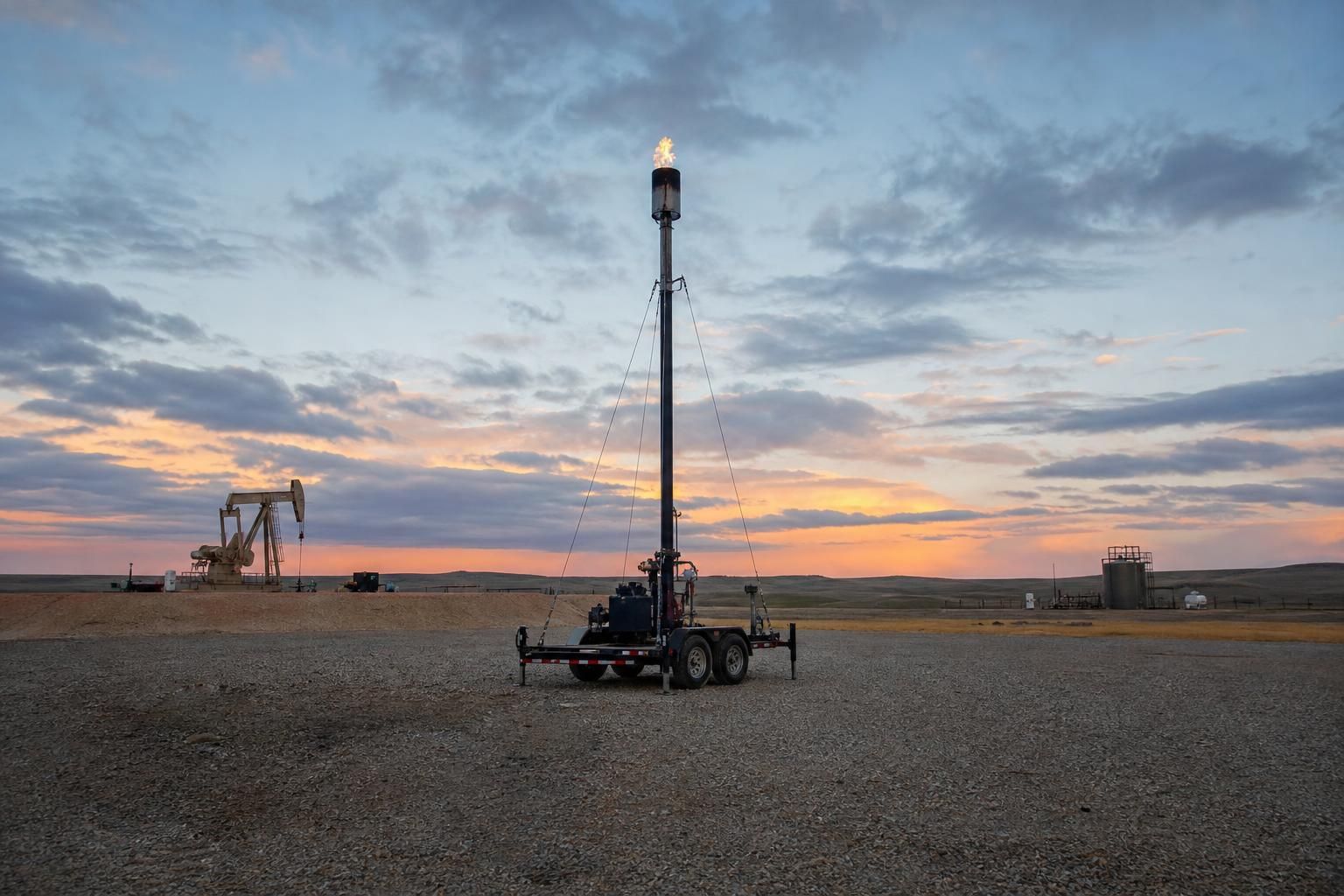
Not every gas stream justifies a permanent flare stack. Well testing, flowback, startups, turnarounds and temporary production all create short windows when gas has to be handled safely, and then the need is gone. For those situations, a trailer-mounted flare is often the practical answer. This guide explains where portable units fit, what to plan before one arrives on site, and how to think about the choice between portable and permanent equipment in 2026.
What Makes a Flare Portable
A portable flare packages the stack, pilot, ignition system and controls on a trailer chassis. The stack is typically lowered for transport and raised on site. Once positioned and connected to the gas line, it can be commissioned much faster than a fixed installation that needs foundations, guying and permanent piping. That speed is the main reason crews choose a trailer mounted flare for temporary work.
Common Uses in the Field
- Well completion and flowback: managing gas from a well while it cleans up and before a sales line is available.
- Production startups: giving a new facility a safe outlet while equipment is being proven out.
- Plant turnarounds and maintenance: handling gas that is displaced when units are depressured or purged.
- Backup service: covering periods when a permanent flare or recovery system is out of service.
- Remote or short-life sites: where the economics of a fixed installation do not add up.
Portable Versus Permanent: A Practical Comparison
Portable flares trade long-term durability and capacity for flexibility. A fixed flare is built for continuous duty, larger and more variable flows, and long service life. A portable unit is built to be moved, set up quickly and used for a defined period. Neither is better in the abstract. The right choice depends on how long the gas will flow, how much of it there is, and what the site permit allows.
If the same site keeps calling for a temporary unit year after year, it is worth asking whether a permanent solution would cost less over time. If the need is truly short-term, renting a portable unit avoids tying up capital in equipment that will sit idle.
Planning Before the Unit Arrives
Most problems with temporary flaring come from rushed planning. A few checks save a great deal of trouble:
- Define the gas stream. Know the expected flow range, composition, pressure and whether liquids may carry over.
- Check the permit. Confirm that temporary flaring is allowed at the location and under what conditions.
- Choose the location. Consider distance to people, structures, tanks and vegetation, plus prevailing wind and access for the trailer.
- Plan the piping. Provide a knockout vessel or liquid separation where needed and keep the line sizing suitable for the flow.
- Confirm the ignition and pilot approach. Understand how the pilot is supplied and monitored.
- Set up safe procedures. Make sure everyone on site knows the start-up, shutdown and emergency steps.
Safety and Operations
A flare is a combustion device, and it deserves the same discipline as any other. Keep the area around the stack clear. Verify the pilot is lit before and during gas flow. Keep a watch on flame stability, particularly if the gas composition or flow changes. Stay alert to weather, since high winds can affect stability and radiant heat patterns. For longer rentals, set up regular inspection rounds and keep a simple log.
Why Combustion Equipment Is Not Only About the Stack
The flare is one piece of the system. Gas handling upstream, vapor control, and in some cases enclosed combustion all play a role in meeting site goals. If you are weighing options for managing low-pressure vapors or enclosed destruction, a vapor control unit may be worth reviewing alongside open flaring, since the best answer often differs by site and by regulation.
Cost Thinking for Temporary Flaring
When comparing options, look past the daily rate. Consider mobilization and demobilization, site preparation, labor for monitoring, fuel for the pilot, and the cost of downtime if equipment is not ready when the gas arrives. A supplier who can talk through these items clearly is generally easier to work with than one who only quotes a rate.
Frequently Asked Questions
How fast can a portable flare be set up?
Setup is usually much quicker than a permanent installation, since the unit arrives assembled on a trailer. The exact time depends on site access, piping and permitting.
Is a portable flare suitable for long-term use?
It can serve for extended periods in some cases, but if the need is continuous, a permanent installation is worth evaluating.
Do I need a permit?
Requirements vary by state, location and facility type. Confirm with your environmental contact before mobilizing.
What information does a supplier need?
Expected flow rate, gas composition, pressure, duration and site location are the basics.
Can a portable flare handle liquids in the gas?
Liquids should be removed upstream with a knockout vessel, since carryover can cause unstable burning and safety problems.
Used well, a portable flare gives operators a flexible, quick way to handle gas for a defined period. Good planning on gas data, permits and placement is what turns a temporary rental into a smooth job.